
Claim timeline
How long does flight compensation take?
A full timeline guide to flight compensation claims, including document review, authorization, airline response, escalation, settlement, and payout review.
- Clear customer status
- Human-reviewed escalation
- Careful payout review
Quick answer
The practical answer
A simple accepted claim can move faster, but disputed claims can take weeks or months. The strongest predictor is not the airline name alone; it is whether the file has complete evidence, signed authorization, a clear route, and a real escalation path if the airline does not cooperate.
- Document gaps are the most preventable delay.
- Airline response timing is outside AirReclaim's control.
- UK complaint routes often require giving the airline time to respond before escalation.
- Customer payouts are checked before transfer.
A compensation claim is a sequence, not one wait
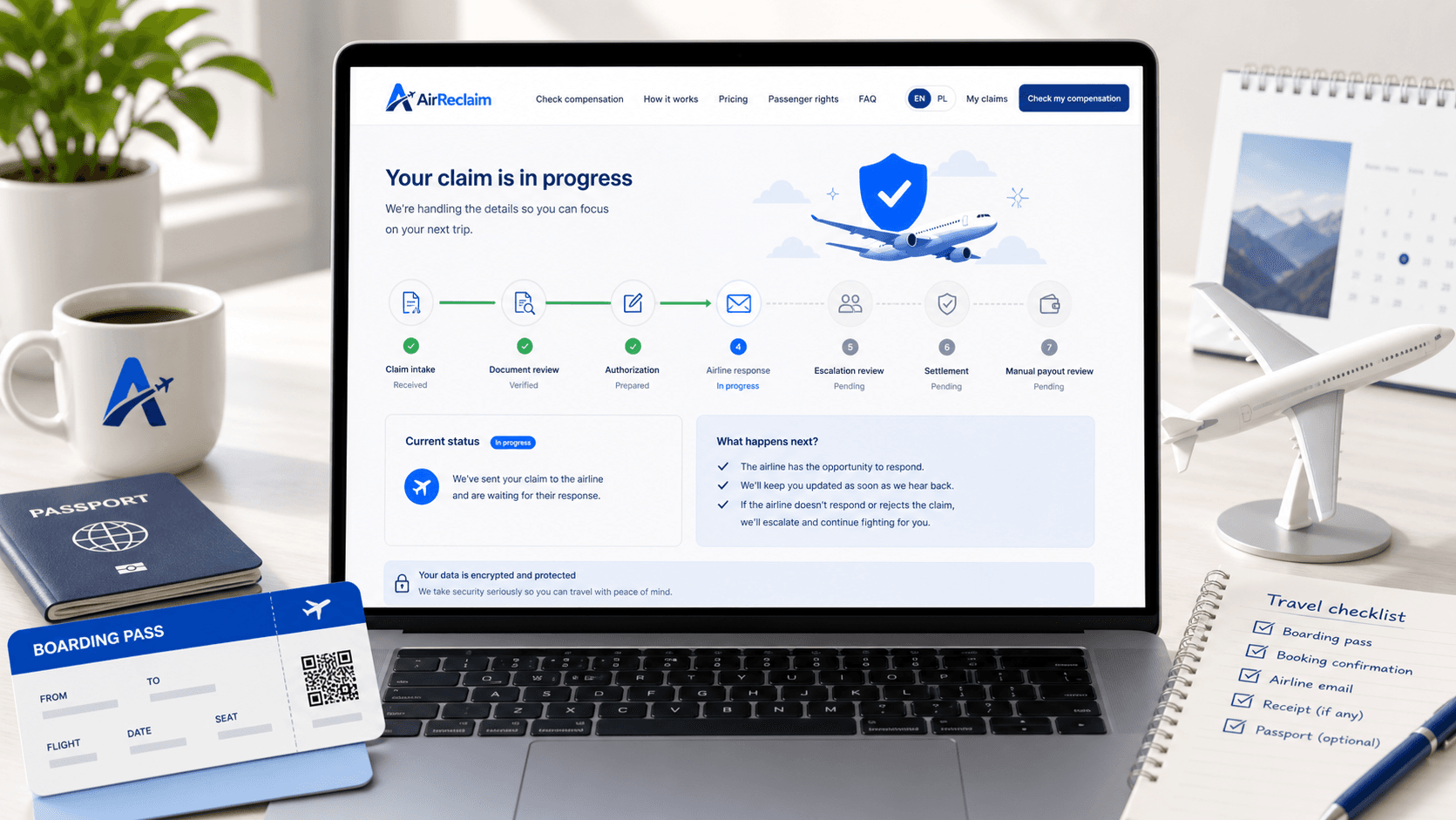
Passengers often ask for one timeline, but the process is made of several waits: evidence collection, AirReclaim review, authorization, airline handling, possible escalation, settlement review, and payout checks.
A delay at any stage changes the total time. A complete file with an accepting airline can move quickly. A file with a missing boarding proof, disputed extraordinary circumstances, unclear operating carrier, or authority escalation can take much longer.
Typical claim stages
| Stage | Who acts | What can slow it down |
|---|---|---|
| Intake | Customer | Missing route, passenger, or disruption details. |
| Document review | AirReclaim | Cropped uploads, unclear final arrival, missing airline messages. |
| Authorization | Customer | Unsigned or incomplete passenger authority. |
| Airline submission | AirReclaim | Missing delivery channel, unresolved evidence question, or route risk. |
| Airline response | Airline | Rejection, no response, more-information request, or settlement offer. |
| Escalation | AirReclaim or approved partner | ADR, PACT, authority, or legal review requirements. |
| Payout review | AirReclaim finance | Direct airline payment, fee review, missing recipient details. |
Stage 1: intake and document review
The first review confirms whether the claim is coherent enough to work on. AirReclaim checks the route, operating carrier, disruption type, final arrival impact, passenger details, and document evidence.
A claim may pause here if the customer entered the marketing carrier instead of the operating carrier, omitted a connecting segment, uploaded unreadable documents, or mixed refunds and compensation into one unclear upload.
- Complete uploads usually reduce support back-and-forth.
- Missing evidence does not always kill a claim, but it can block submission.
- Dashboard messages should be used for case-specific clarification.
Stage 3: airline submission and airline response
After submission, the airline can accept, reject, ask for more information, offer a settlement, pay the customer directly, or fail to respond within a useful timeframe. Each response creates a different next action.
AirReclaim does not represent airline response timing as guaranteed. The dashboard should show the last event, who acts next, and what the customer can do if more information is needed.
Direct airline contact matters
If the airline contacts or pays the customer directly, the customer must report it in the dashboard. It can affect fee calculation, payout review, and whether AirReclaim should continue.
Stage 4: escalation, ADR, PACT, or authority review
If the airline rejects the claim or does not respond, escalation depends on the route, airline, jurisdiction, and available approved delivery channel. EU, EEA, Swiss, and UK routes do not all escalate to the same destination.
For UK complaints, CAA guidance commonly points passengers through the airline complaint route first and then to ADR or PACT where appropriate. AirReclaim escalates only when the destination, evidence, and authorization are ready.
| Situation | Likely next review | Customer expectation |
|---|---|---|
| Airline asks for documents | Evidence gap review | Upload the requested item or explain why it is unavailable. |
| Airline rejects responsibility | Rebuttal or escalation review | AirReclaim checks whether the reason is answerable. |
| Airline does not respond | Timing and jurisdiction review | Escalation may depend on waiting-period rules and available channels. |
| Authority requires an online form | Manual review route | The dashboard should explain why AirReclaim cannot send directly yet. |
Stage 5: settlement and payout review
If compensation is recovered, AirReclaim reviews the recovered amount, fee treatment, payout recipient details, direct airline payments, and any case-specific issue before closing the claim.
Payout timing depends on the recovered amount, fee review, recipient details, and whether the airline has already paid the customer directly. AirReclaim will confirm the next step in the claim dashboard.
Payout review note
AirReclaim checks recovered funds, fee treatment, and recipient details before confirming payout timing. Customers should report any direct airline payment as soon as it happens.
What passengers can do to avoid avoidable delays
Customers cannot control airline response timing, but they can reduce preventable delays. The most useful actions are completing the claim accurately, uploading complete documents, signing authorization promptly, and responding to dashboard messages.
Duplicate airline complaints, hidden direct settlements, mismatched passenger names, and unclear documents can all create extra review work.
- Upload the full booking confirmation and boarding proof.
- Keep every airline message and rejection letter.
- Report direct payments, vouchers, refunds, and settlement offers.
- Use the claim dashboard instead of separate email threads for case details.
Common questions
No. Evidence quality, airline response, jurisdiction, and escalation route all affect timing. AirReclaim can show status and next action, but it cannot guarantee airline or authority response speed.
Explore related guidance
Move to a related claim type, a detailed guide, or a reviewed airline page.
Start with a complete file.
The preliminary checker helps identify route, evidence, authorization, and timing issues before the claim becomes a live case.